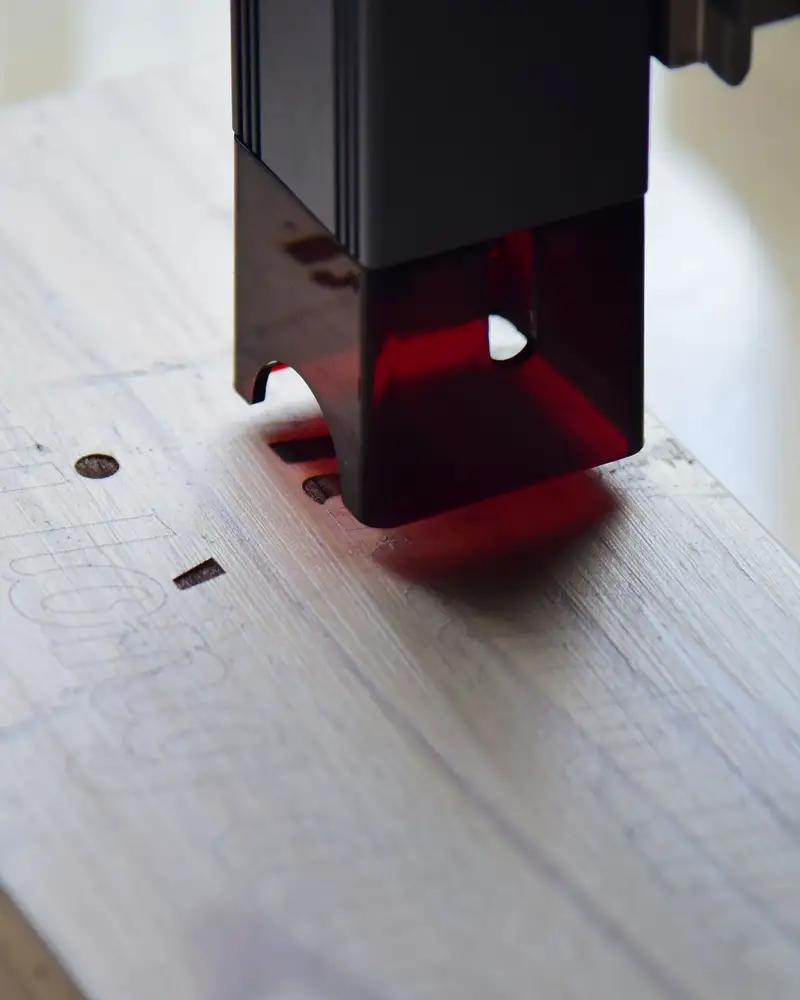
Diode, CO2, and fiber lasers
Diode A blue beam for wood, leather, and dark sheet.
As an Amazon Associate, LaserNook earns from qualifying purchases.
A diode laser uses a visible blue beam, often near 445 nm. It is the usual first machine for wood, leather, and dark or coated sheet.
It does not mark clear acrylic the way a CO2 does, and it does not mark bare metal the way a fiber laser does. Glasses have to match this wavelength. An enclosure keeps the beam in a box. This is buying advice, not a test of a brand.
Best for
- Wood
- Leather
- Dark acrylic
- Coated metal
As an Amazon Associate, LaserNook earns from qualifying purchases.
CO2 An enclosed tube for clear acrylic and wood.
As an Amazon Associate, LaserNook earns from qualifying purchases.
A CO2 laser is a tube inside a box. It cuts wood and engraves clear acrylic, which a diode struggles to mark.
The glasses for a CO2 tube are not the diode pair. The tube, the mirrors, and the water or air cooling are part of owning it. Read that manual before you compare it with a desktop diode.
Best for
- Clear acrylic
- Wood cuts
- Leather
- Paper
As an Amazon Associate, LaserNook earns from qualifying purchases.
Fiber / IR A metal marker for tags, tumblers, and bare steel.
As an Amazon Associate, LaserNook earns from qualifying purchases.
A fiber laser, often at 1064 nm, marks metal: bare steel, anodized tags, and some coated tumblers. It is a marker more than a wood cutter.
The glasses are a third pair, not the diode pair and not the CO2 pair. Buy it when metal is the job. It is a poor first machine if you wanted coasters.
Best for
- Bare metal
- Anodized tags
- Coated tumblers
As an Amazon Associate, LaserNook earns from qualifying purchases.
Dual laser Two heads in one machine. Usually diode plus infrared.
As an Amazon Associate, LaserNook earns from qualifying purchases.
A dual laser puts two modules in one machine, often a diode plus an infrared head. The idea is wood and some metal without buying two boxes.
You still match glasses to the head that is on. Setup is two machines’ worth of settings. It is optional, not a simpler first laser.
Best for
- Wood and metal
- Mixed jobs
- One machine
As an Amazon Associate, LaserNook earns from qualifying purchases.